Creating Division Spirit: The Origin of the 29th Division Insignia

By Alexander Falbo-Wild

In 1917, the US Army faced fighting a war with new technology, tactics, and organization. For centuries, regiments had been the predominant tactical formation for European countries which later informed the Continental Army structure. But this was displaced in favor of the division at the start of the 20th century. Divisions existed in the American Civil War, but the scope and character of the fighting in the early 20th century meant that the division would become the organizational building block for conducting future operations.[1]
At 28,000 strong, a US Army division in the Great War was twice that of its average German, French, or British counterpart. Yet, it was small enough to be identifiable: a corpus of soldiers able to bond through shared campaign experiences and collective victories. Even before the doughboys exchanged the first shots against their German opponents across no man’s land, “it was soon realized that a divisional spirit or esprit must be encouraged.”[2] And the Maryland National Guard would play an important role in the creation of that new esprit and identity.
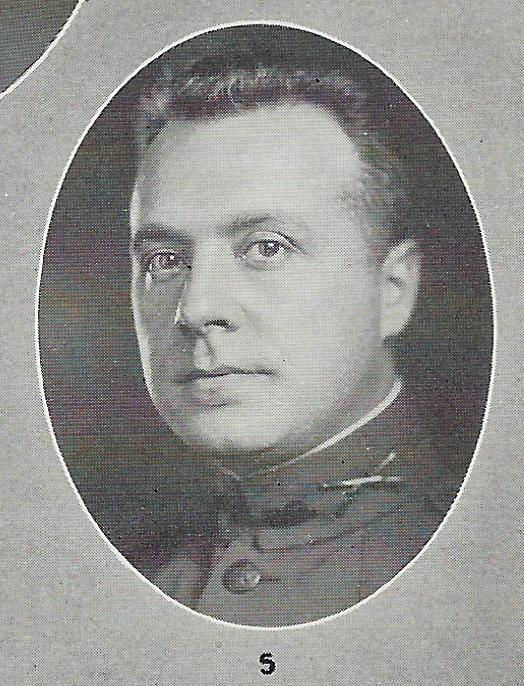
The 29th Division would ultimately be brought together for training at Camp McClellan, Alabama. It was here that the famous divisional emblem was proposed by Maj. James A. Ulio, the division adjutant. Smart in both appearance and intellect, he was drawn to the fact that the 29th was nick-named the “Blue and Gray division” based on its composition of former northern and southern state units. The Civil War was only fifty years past and there was pride in the accomplishment of forging these units together. “Moreover,” as the divisional history notes, “these men were trained in a southern camp named in honor of a Federal General and were commanded by an officer [General Charles G. Morton] of the United States Army from the State of Maine.”
Major Ulio thus chose the monad or yin-yang, the Korean symbol of life, with blue and gray occupying its colored tear shapes. Often confused with the taijitu symbol, which features two additional small circles in those shapes and popularized in the 1960s, the yin-yang represented not just a balance between good and evil, but also a Chinese philosophical conception of dualism between complementary qualities. The design was sent to the War Department and approved in December 1917 for use, not on shoulder sleeves, but the divisional property and transport. A practice already widely used by European divisions (especially on the Western Front). It was the first of the American divisions to do so. The idea for wearing the emblem on the shoulder would take another year to materialize.
Many division commanders – including General Morton – were sent to the Western Front in early 1918 for orientation on the terrain, operations, and technologies they would soon engage. During that time, General Charles J. Bailey leading the 81st Division, was struck by the appearance of division markings on not only division property, but of the particularly British practice of division flashes and identification schemes on uniforms and helmets. Gen. Bailey eventually persuaded General Pershing on the merits of easy identification in “handling small units in the present methods of advance in open warfare” and as a means that “would promote good fellowship” where “the insignia brings individuals together that would not otherwise know or care for one another.”[3]
On 21 October 1918, as the 29th Division finished grappling with Austrians and Germans for the shattered Meuse-Argonne Heights, Pershing’s H.Q. formally approved the 29th’s emblem for the upper left shoulder.[4] So began the custom of wearing the coveted Blue and Gray on the sleeve, where the tradition is slapped on the left arm of those joining its ranks today.
[1] Alexander Falbo-Wild, “Rising to the Occasion: US Army Expansion in the World Wars, 1900-45,” in How Armies Grow: The Expansion of Military Forces in the Age of Total War, 1789-1945, ed. Matthias Strohn (Oxford: Casemate, 2019), 130.
[2] John A. Cutchins, History of the Twenty-Ninth Division “Blue and Gray” 1917-1919 (Philadelphia: MacCalla and Co. Inc., 1921), 16.
[3] H. Ross Ford, Shoulder Sleeve Insignia of the American Expeditionary Forces 1918-1919 (Atglen, PA: Schiffer Military History, 2012), 134–35.
[4] Ford, 87.


Comments